Guide

Precision down to the last detail: Where standard production ends

When you buy a sanding machine, you're buying a result. In most applications, a well-built machine reliably delivers this result. However, there's an area where the difference between machines is no longer measured in percentages, but in hundredths of a millimeter. And that's precisely where standard production stops.
Your Contact Person
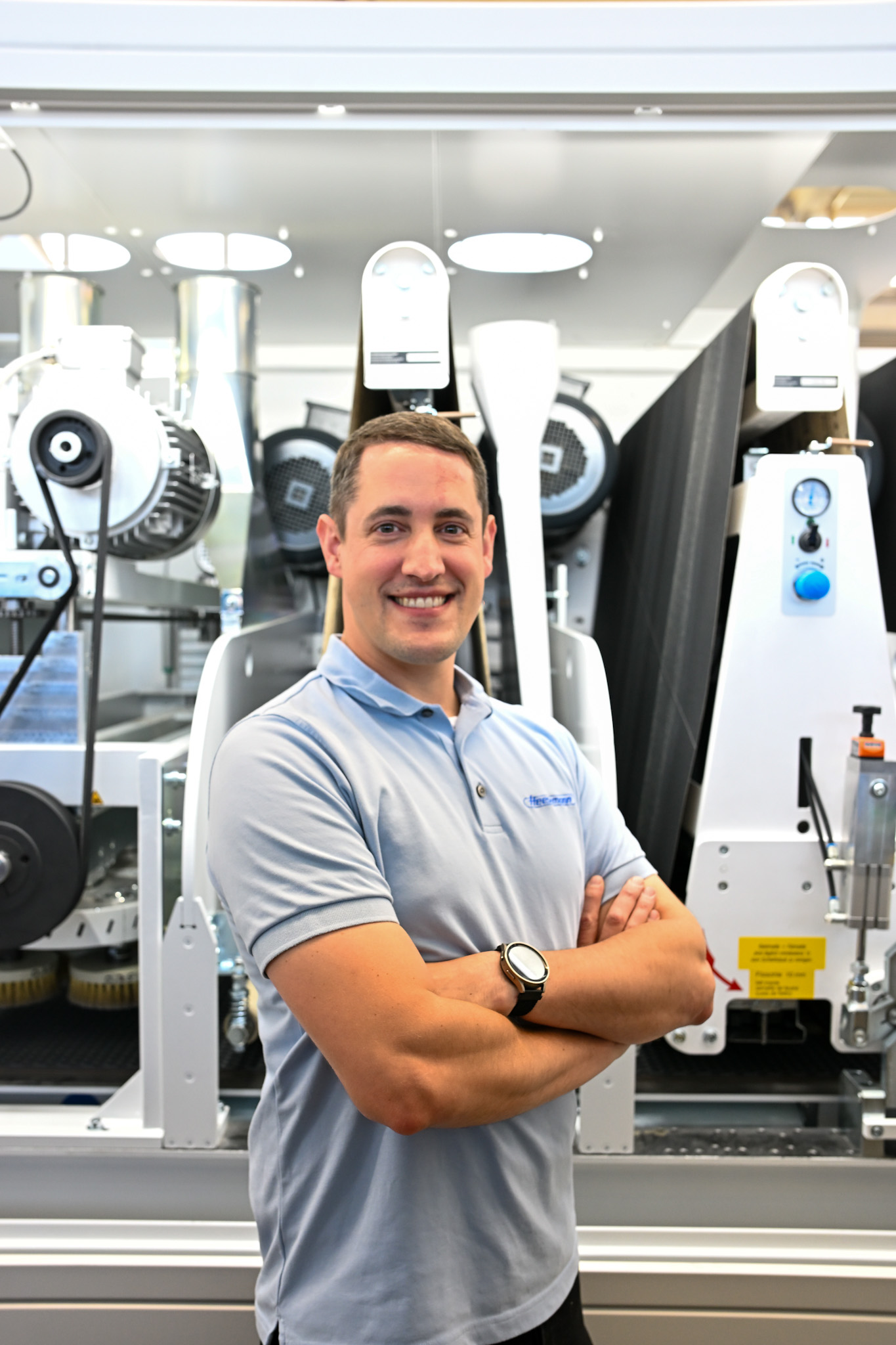
Pascal Diller
Head of Engineering & Development
Expert Profile
Credit card mockup

What is meant by standard production

The grinding process

Wer einen Hundertstel fordert, also eine Größenordnung präziser, verändert die Ausgangslage grundlegend. Nicht weil sich die Zahl nur um eine Stelle verschiebt, sondern weil auf diesem Niveau jede Abweichung in der Maschinenmechanik, jede Ungenauigkeit in der Aggregatausrichtung und jede Schwingung im Maschinenrahmen direkt im Ergebnis sichtbar wird.

Auf diesem Niveau kann sich die Maschine nicht mehr auf gute Konstruktion allein verlassen. Sie muss von Grund auf präzise aufgebaut sein.

What becomes visible at this level

In normal operation, many inaccuracies remain hidden. An assembly that is misaligned by a few hundredths of a millimeter still produces an acceptable result, as long as the requirements are not too high.

As soon as the goal is a flawless high-gloss finish, or a surface that must appear absolutely uniform under grazing light, these inaccuracies become visible.

Errors do not arise from incorrect settings on the control panel. They are inherent in the machine itself, due to manufacturing inaccuracies that were not eliminated during construction.

Why extreme cases require different preparation

Theoretically, anyone can meet standard application requirements. Heesemann machines truly excel in extreme cases because the necessary precision is already embedded in the care invested in the machine's exact setup before delivery.

This means: The quality of the result a machine delivers in extreme cases is determined not during operation, but during final assembly.

A machine built for standard applications can be optimized in its settings, but it cannot be brought to a level that its mechanics cannot support. The limit is structurally defined.

The Investment Argument

Machines for the last hundredth of a millimeter cost more. There's a direct reason for this: they require more effort in manufacturing. More care in alignment, more rework on components that don't fit immediately, more experience from technicians who know where a machine's critical points lie.

This additional effort is reflected in the price. At the same time, it's reflected in durability and consistency. A machine built to this standard maintains this quality for years. It doesn't drift, nor does it increasingly produce sanding pattern problems over time due to wear, which would set in faster with less precise basic assembly.

For companies that rely on consistent surface quality in their product segment, this is not a luxury argument, but an economic calculation.


Who has these requirements

Not every company operates in this range. Anyone sanding mass-produced furniture for the entry-level market doesn't need a machine chasing a hundredth of a millimeter. For them, a powerful standard machine is usually sufficient.

However, those who work in the premium segment, be it high-quality parquet flooring or furniture surfaces, laminated panels with tightly defined tolerance requirements, or metal surfaces with optical quality criteria, cannot maintain their product positioning with a standard machine.

These companies often know exactly at what point they reach the limits of their current machine. The point is recognizable: The result is good, but not good enough. And it's no longer possible to extract more through adjustment optimizations.

How this relates to machine selection

The decision for a machine that can operate down to the hundredth of a millimeter, and maintain that over decades, is not a decision that can be made up for during ongoing operations. It must be made at the time of purchase.

Anyone who buys a machine designed for standard applications and later realizes they need precision faces a choice: either live with the results, or acquire a new machine.

Therefore, the most honest question before an investment decision is not how much machine you can afford, but: What quality level does your market demand, today and in five years?

Conclusion

The last hundredth of a millimeter is not a technical gimmick. It's the range where it's decided whether a company can bring its product to the quality level its customers expect.

Standard production stops where the machine's tolerances become tighter than the product's tolerances. Anyone who consistently works in this range needs a machine specifically built for it.
This article is based on an expert discussion with Pascal Diller, Head of Engineering at Heesemann.