counsels

Sanding wood surfaces — The complete guide
Why a complete overhaul saves over 30%

From calibration to effect grinding, discover how Heesemann wood sanding machines set standards in precision, efficiency and automation. Your guide to perfect surfaces.
Your Contact
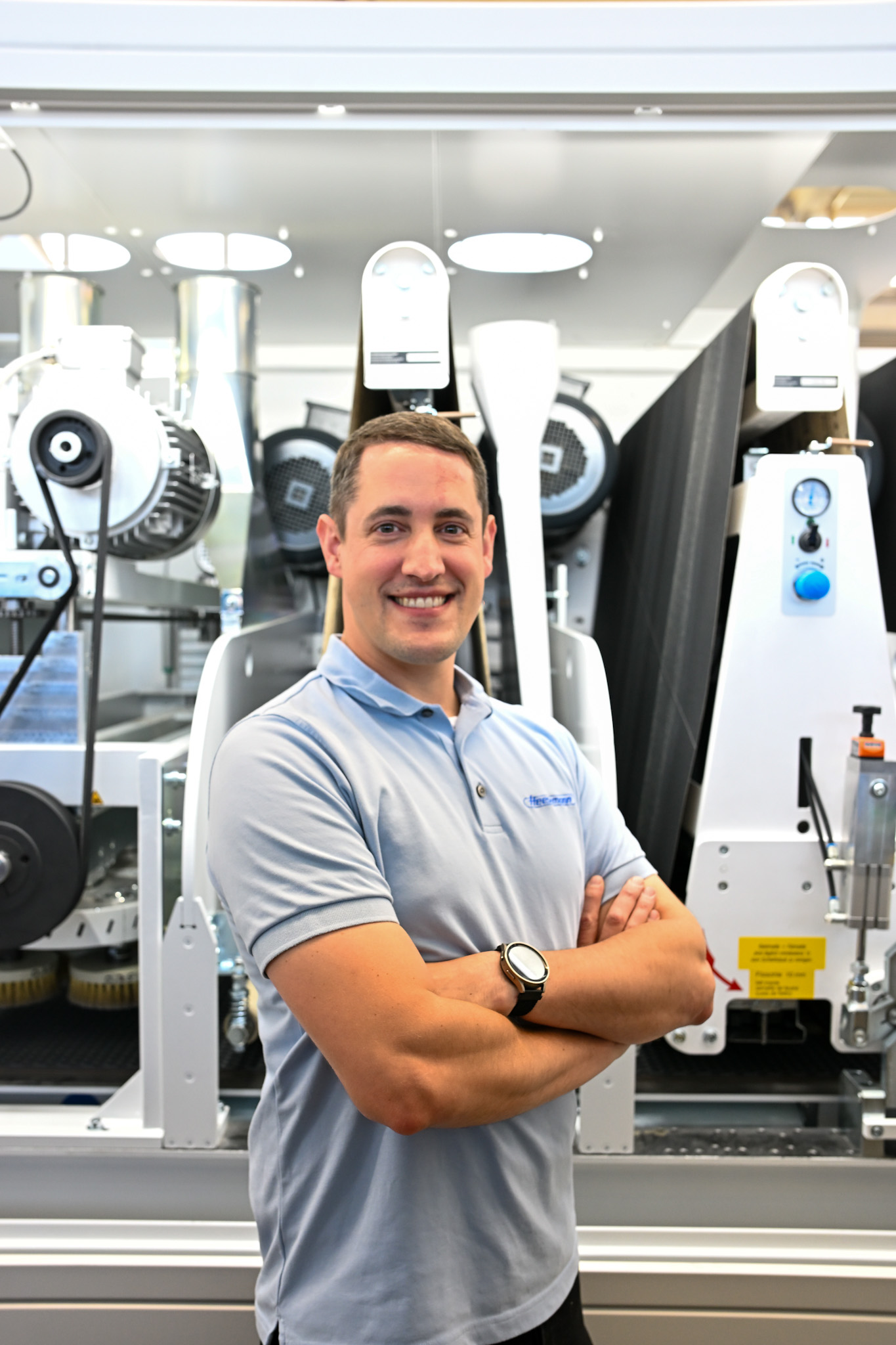
Pascal Diller
Head of Engineering & Development
To the Expert Profile

The Starting Point: Optimization of an Existing Model

The grinding process

Wertanalyse kann in solchen Projekten 15 bis 25 Prozent Kostenreduktion erzielen. Das ist ein solider Wert. In vielen Fällen ist es der richtige Weg.

In diesem Fall war er es nicht. Der Grund wurde schnell deutlich: Die Optimierungen, die eine klassische Wertanalyse an einer bestehenden Maschine erlaubt, führen an einem bestimmten Punkt zu Qualitätseinbußen. Weniger Schrauben bedeutet weniger Stabilität. Dünneres Blech bedeutet mehr Schwingung. Fehlende Sensoren bedeuten weniger Funktionsumfang. Jede Kosteneinsparung war mit einem Kompromiss verbunden, der nicht akzeptabel war.

The Decision: A Fresh Start

The step that changed everything was easy to describe and hard to take: clearing the whiteboard and starting anew.

In a development round, five lines were drawn on a board: ground, fixed points at the top. Everything in between was open. No existing design as a reference, no predefined components, no dependencies on what was already there.

Within an hour, a new concept for a machine architecture emerged in this round. A concept based on three fundamental principles:

- Symmetry in machine construction
- Common parts wherever possible
- Standardized interfaces between all assemblies

These three principles are not new.
They are tenets of efficient mechanical engineering. But consistently applied to a machine that was previously built without them, they unleash an effect that would not have been achievable through gradual optimization.

What symmetry and common parts specifically achieve

Symmetry in machine construction means that the left and right sides, front and rear assemblies are built according to the same dimensions and positions. This sounds obvious, but it often isn't in evolved machine designs. If a machine has been gradually developed over years, asymmetries arise: an additional component here, a different screw position there.

Symmetry eliminates these asymmetries from the ground up. The result is assemblies that can be used symmetrically. Instead of a left and a right part, there is one part that can be used on both sides. The variety of variants decreases, and the number of parts in the bill of materials decreases.

Common parts reinforce this effect. Where previously two similar but not identical components were used, there is now one. This has direct effects on purchasing, warehousing, manufacturing, and assembly: fewer variants mean more favorable purchasing conditions, lower storage costs, simpler manufacturing processes, and fewer sources of error in assembly.


The result: more than 30 percent cost savings

Starting from a blank slate led to cost savings of well over 30 percent compared to what a classic value analysis on the existing machine would have achieved. And without compromising quality.

On the contrary: The new machine is heavier than its predecessor. More mass means more stability, less vibration, a more uniform grinding pattern. The value of the product has increased. Costs have decreased.

This result was not achievable through value analysis on the existing model. It was only possible because all dependencies on the previous design were abandoned.

Why this path is harder than it sounds

Starting from a blank slate is a simple idea. In practice, it is difficult to implement because it requires setting aside years of accumulated design knowledge.

Experienced developers know the existing machine. They know its weaknesses, its proven solutions, and the reasons why certain decisions were made the way they were. This knowledge is valuable. But it also creates mental barriers.

The approach of starting from scratch works best when combined: with the experiential knowledge of those who know the old machine, and the fresh perspective of those who approach the task without preconceptions. Both perspectives together produce results that neither group alone could have achieved.

What this approach means for future developments

The new machine architecture that emerged from this fresh start is not the final product. It is the foundation for a scalable platform on which future machines will be built.

Standardized interfaces make it possible to combine different construction types. Common parts across series reduce development and manufacturing effort for each new variant. Symmetrical designs simplify configurators because fewer special cases need to be handled.

The fresh start has therefore not only improved one machine. It has created an architecture that serves as the basis for the digitalization and scaling of the entire machine platform.

Conclusion

Value analysis is the right tool for the right job. If the task is to optimize an existing product within its limits, it is effective.

If the limits themselves are the problem, only a fresh start helps. It requires courage. It demands the willingness to let go of what has been learned. And it requires the decision to make it in the first place.

At Heesemann, this decision led to a machine that is more stable, more cost-effective, and more future-proof than anything gradual optimization could have achieved.
This article is based on an expert discussion with Pascal Diller, Head of Engineering at Heesemann.