Guide

What truly defines a precise sanding machine

Building a good sanding machine is achievable. Building a precise sanding machine is a different task. The difference lies not primarily in engineering, material selection, or control technology. It lies in the people who assemble it.
Your contact person
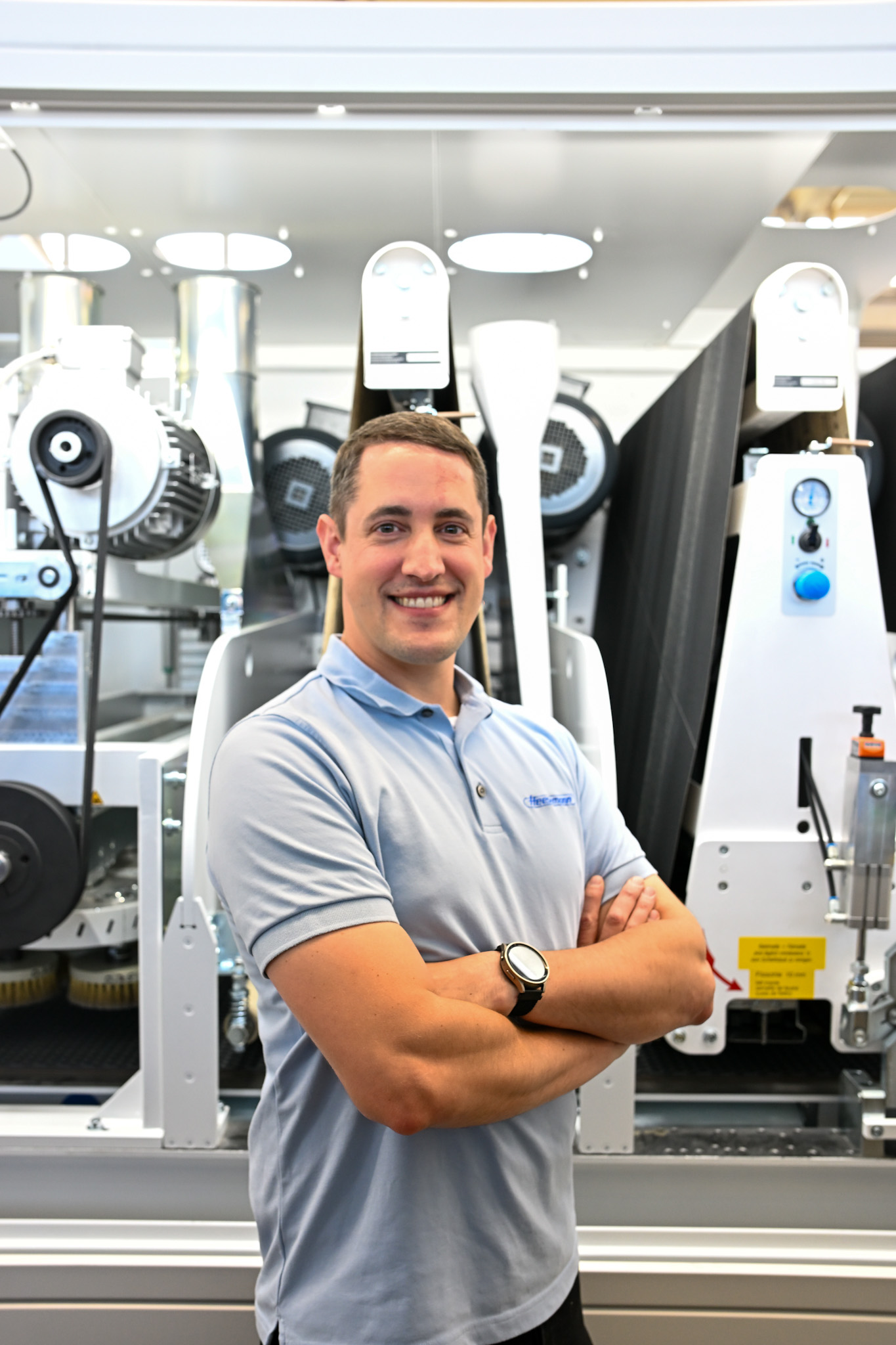
Pascal Diller
Head of Engineering & Development
To the expert profile

1. Why sanding wood surfaces is crucial

Sanding is one of the most important steps in wood processing —

Was eine präzise Schleifmaschine von einer guten Schleifmaschine unterscheidet, ist die Qualität der Montage. Konkret: wie sorgfältig jede einzelne Baugruppe ausgerichtet wird, wie viel Zeit dafür aufgewendet wird, dass Bauteile nicht nur zusammenpassen, sondern exakt zueinander stimmen.

Technik kann kopiert werden. Das Know-how, sie richtig zu montieren, nicht.

What really happens during final assembly

At Heesemann, every machine undergoes extensive alignment during final assembly.

Specifically, this means:
Consistent quality over large areas
Maximum material utilization through precise calibration
Perfect match between wood type, abrasive and aggregate
Technology meets craftsmanship

Das Prinzip ist klar: Nichts wird „fünf gerade sein" gelassen. Wenn ein Bauteil nicht stimmt, wird es nachgearbeitet, bis es stimmt.


Why humans are the decisive factor

Maschinenbau-Unternehmen weltweit nutzen ähnliche Komponenten, ähnliche Fertigungsverfahren und ähnliche Steuerungstechnik. The grinding process

Präzision ist das Ergebnis einer Haltung. Wer in der Produktion auf Zeit und Schnelligkeit optimiert, wird gute Maschinen bauen. Wer zusätzlich auf Sorgfalt und Detailgenauigkeit optimiert, baut präzise Maschinen.

Dieser Unterschied wird im Normalbetrieb nicht sichtbar. Eine Standardanwendung kann eine Vielzahl von Maschinen bewältigen. Der Unterschied zeigt sich erst dort, wo die Anforderungen an die Oberfläche oder die Maßhaltigkeit so hoch sind, dass jede nicht perfekt ausgerichtete Baugruppe als Fehler sichtbar wird.

Precision in the last percent

There is a threshold at which the difference between machines becomes measurable and visible: in the last one to two percent of achievable quality.

Many machines can deliver a tenth of a millimeter in tolerance. However, those who demand a hundredth of a millimeter or a consistent, reproducible surface finish over hours and shifts will find that the number of machines capable of consistently delivering this is significantly smaller.

It is precisely in this area that the number of hours and days previously invested in meticulous alignment and assembly makes the difference. Precision is not a setting. It is the result of a process.

What this means for customers

Not every customer needs a precise sanding machine. For standard applications with defined, medium quality requirements, suitable machines are available at lower prices.

Customers who rely on Heesemann machines can be divided into two groups:

Large, standardized producers who require precisely reproducible results over many years. For them, precision is not a comfort feature but a production prerequisite. A fluctuation in surface quality means rejects, complaints, or rework for their customers.

Manufacturers in the premium segment who offer the highest quality in their industry, whether furniture, flooring, wood surfaces, or metal. They cannot use a machine that fails to consistently deliver this level of quality. For them, the machine choice is directly linked to their own market positioning.

What both customer groups have in common is that a less capable machine is not an option for them – not for status reasons, but because it would prevent them from bringing their own products to the required level.

Why this approach cannot be scaled indefinitely

The principle described – meticulousness, time, experience – only works under specific conditions. It requires employees who have built up this knowledge. It requires a corporate culture that prioritizes quality over speed when the two conflict. And it requires a production process organized in such a way that this meticulousness is even possible.

This explains why precision in this form cannot be easily replicated in production facilities primarily focused on volume and speed. The pressure to deliver quickly and the demand to deliver precisely are inherently at odds.

Heesemann produces in Bad Oeynhausen. The decision to produce there is not based on tradition. It is a decision based on quality.

Conclusion

Precision is not a technical feature that can be captured in a data sheet. It is the result of expertise, meticulousness, and the commitment to leave nothing incorrect.
This makes it complex. But it also makes it reproducible for customers who rely precisely on this reproducibility.
This article is based on an expert discussion with Pascal Diller, Head of Engineering at Heesemann.